Authority active USDOT 1560304 MC-578813 Verify on FMCSA ↗
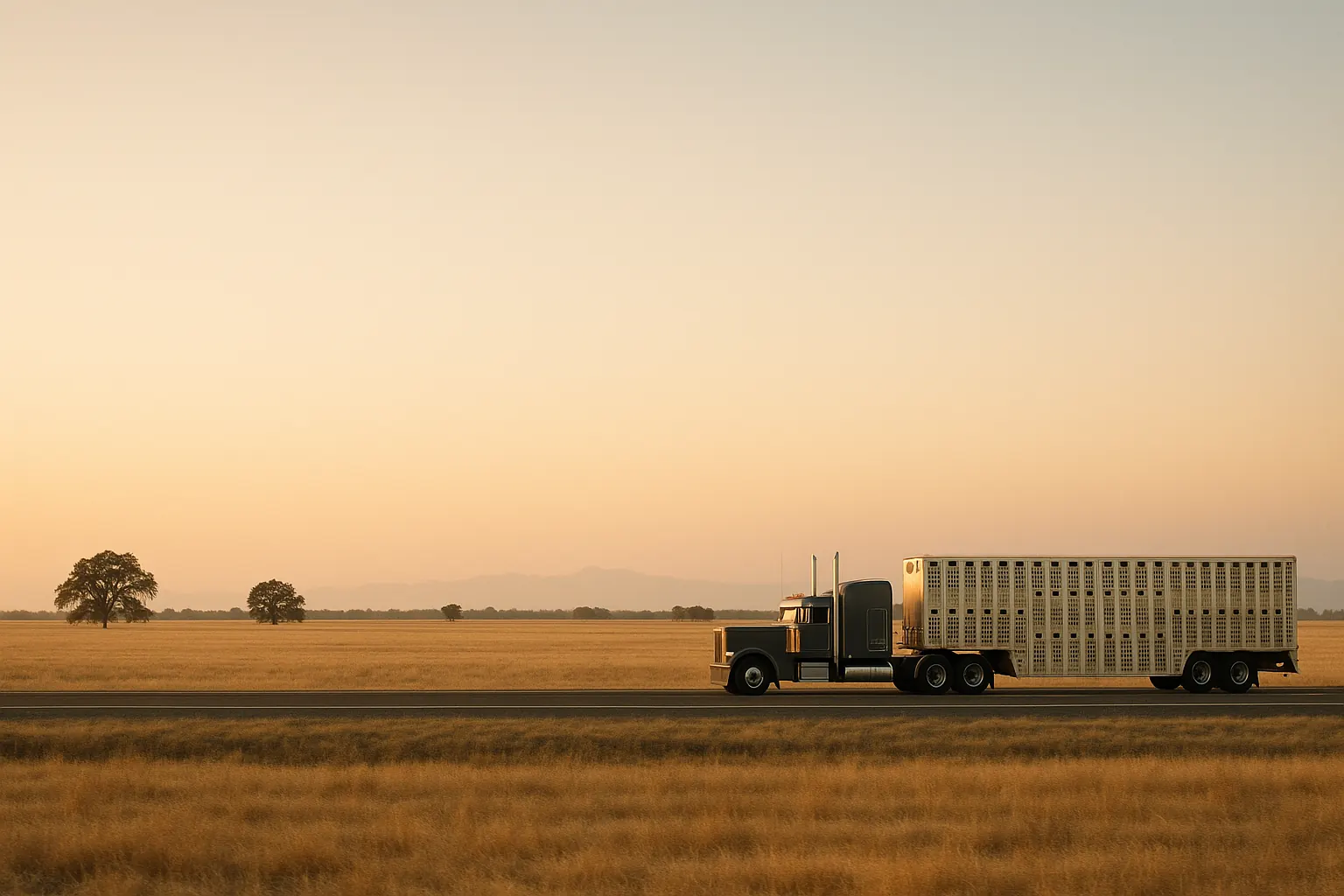
A semi truck pulling an aluminum livestock trailer along a two-lane highway across golden Sacramento Valley grassland at sunset
Livestock, nut & farm freight · Willows, CA

Cattle and farm freight, handled like it's our own.

An owner-run, FMCSA-authorized carrier hauling cattle, almonds, walnuts, hay and farm supplies across the Sacramento Valley and beyond, since 2006.

2006Operating under our own federal authority since
0Reportable crashes in the last 24 months
36%Lower vehicle out-of-service rate than the national average
I-5Home base on the Interstate 5 corridor, midway up the valley
What we haul

Cattle, nuts and farm freight. Done properly.

Everything we haul comes off a ranch, out of an orchard or onto a farm. We know the seasons, the handling and the people at both ends of the load.

Black Angus cattle waiting calmly in a wooden corral beside a steel loading alley at dawn Livestock
01 — Livestock

Cattle hauling

Ranch to sale yard, sale yard to feedlot, winter ground to summer grass. Loaded quietly, driven smoothly, and delivered with the count you shipped.

  • Ranch, sale yard, feedlot and pasture moves
  • Head count and weights confirmed before loading
  • Runs timed around heat, weather and the animals' welfare
  • Long hauls planned within the federal 28-Hour Law
In-shell almonds pouring from a conveyor into an open-top bulk trailer at the edge of an almond orchard during harvest Tree nuts
02 — Tree nuts

Almond & walnut hauling

Harvest runs on the orchard's clock. We move almonds and walnuts from the orchard to the huller, sheller and dryer, then on to the processor, and keep loads rolling for as long as the shakers do.

  • Orchard to huller, sheller and dehydrator runs
  • Huller-to-processor and handler deliveries
  • Loads timed to shaking, pickup and receiving hours
  • Walnuts moved promptly, because time on the ground costs quality
A flatbed trailer stacked with strapped hay bales in a farm yard beside a walnut orchard Agricultural
03 — Farm freight

Farm & ranch supplies

Hay, feed and farm inputs moved from supplier to ranch, yard or co-op, as a one-off run or on a recurring schedule through the season.

  • Hay and straw
  • Feed and supplements
  • Farm and ranch supplies
  • Recurring seasonal runs on a set schedule

The valley's hauling year

What moves in Northern California, season by season.

NowMar – May

Spring

Cattle head out to summer grass, the first hay cutting comes off, and the orchards set this year's nut crop.

NowJun – Aug

Summer

Hay season runs full tilt. In August the almond shakers start, and so do the harvest runs.

NowSep – Nov

Fall

Peak almond and walnut harvest. Weaned calves go to sale yards and feedlots, and cattle come down off summer range.

NowDec – Feb

Winter

Hay and feed go out to the ranches, and stockpiled nuts keep moving from hullers to processors.

Nut harvest

Harvest runs on a clock.

Glenn County is almond and walnut country. When the shakers start, the trucks need to be there, and every step between the orchard floor and the processor is a truckload.

Freshly hulled in-shell walnuts heaped in an open-top trailer beside a walnut orchard
Typical Sacramento Valley harvest windowsAlmonds Walnuts
Almonds
Walnuts

Windows shift with variety, weather and the year. The best time to line up harvest runs is before shaking starts.

Almonds

  1. ShakeKnocked from the tree once the hulls split, August into October.
  2. DryLeft on the orchard floor to dry in the sun for about 7 to 10 days.
  3. Sweep & pick upSwept into windrows and picked up out of the rows.
  4. Haul to hullerTrucked to the huller and sheller, often stockpiled there.
  5. DeliverHulled nuts move on to the processor or handler.

Walnuts

  1. ShakeKnocked from the tree once the hulls split, September into November.
  2. Pick up fastNuts left on the ground risk stained shells and kernel damage.
  3. Haul to hullerTrucked to the huller and dehydrator promptly after pickup.
  4. Hull & dryHulls removed and nuts dried to about 8% moisture.
  5. DeliverDried in-shell walnuts move on to the processor or handler.
80%of the world's almonds are grown in CaliforniaAlmond Board of California
99%+of U.S. walnuts are grown in CaliforniaCalifornia Walnut Board
#1Almonds are Glenn County's top crop by valueGlenn County Crop Report, 2021

Sources: Almond Board of California; California Walnut Board; Glenn County Agricultural Commissioner, 2021 Crop Report (almonds $229.8M, walnuts $112.6M); University of California Agriculture & Natural Resources harvest guidance.

How a haul works

One call. A plan. Delivered.

No portals to learn, no call-center queue. Here's what happens after you reach out.

  1. 01

    Tell us the load

    Head count, tons or loads, where from, where to, and when. Use the form below or just call.

  2. 02

    We plan it

    Loading access and receiving hours at both ends, pickup window and route, all confirmed with you before the day.

  3. 03

    Load & roll

    Careful loading and a steady drive, planned around heat, weather, rest and the huller's schedule.

  4. 04

    Delivered

    Unloaded, counted and confirmed. You get a call when the job is done.

Coverage from Willows, California Map of California with 150 and 300 air-mile rings around Willows and reference cities in California, Oregon and Nevada. OREGON NEVADA PACIFIC 300 AIR MI 150 AIR MI CALIFORNIA Redding Chico Yuba City Sacramento Stockton San Francisco Fresno Reno Medford Klamath Falls Bakersfield WILLOWS
Where we run

Midway up the valley, right on I-5.

Willows sits in the middle of the Sacramento Valley. Ranches, orchards, sale yards, hullers and processors across Northern California are a short run away, and our interstate authority takes loads over the line into Oregon, Nevada and beyond.

Air miles from Willows
Chico24 mi
Yuba City41 mi
Redding74 mi
Sacramento75 mi
Stockton119 mi
Reno NV127 mi
Medford OR197 mi
Fresno233 mi

Straight-line distance; road miles run longer. Going somewhere not listed? Ask. Out-of-state runs are welcome.

Safety record

Don't take our word for it.

Every number here comes from the FMCSA's public SAFER database for USDOT 1560304. It's the same record brokers and shippers check before they book.

Reportable crashes · 24 months

0

No fatal, injury or tow-away crashes on record in the last two years.

Vehicle out-of-service rate

14.3%
Us14.3%
Nat'l avg22.26%

36% below the national average across 14 vehicle inspections.

Driver out-of-service rate

6.2%
Us6.2%
Nat'l avg6.67%

Below the national average across 16 driver inspections.

Source: FMCSA SAFER Company Snapshot, USDOT 1560304, report generated 09/09/2026, covering the prior 24 months (17 inspections). National averages as published by FMCSA, 08/28/2026. Out-of-service rate is the share of inspections that ended in an out-of-service order.

Open the live record ↗
Who you're dealing with

A small fleet, on purpose.

Big carriers sell scale. We sell attention: the same people, the same trucks, and a phone that gets answered.

Close view of a charcoal semi truck and aluminum livestock trailer on a valley highway at golden hour
01

You reach the operation

Call dispatch and you're talking to the people who run the trucks, not a call center and not a broker's queue.

02

Same trucks, same drivers

With six power units, the driver at your loading chute is someone we know, in a truck we maintain.

03

Twenty years on valley roads

We've held our own federal operating authority since 2006, moving the valley's cattle and crops, and we still answer for every load personally.

Owned and run by Weldon Dyck · Willows, California

Questions

Before you call.

What do you need from me to quote a cattle haul?

Head count, approximate weights, the class of cattle, pickup and delivery locations, what the loading setup looks like at each end, and your preferred date. The request form below asks for exactly that.

What do you need to quote almond or walnut hauling?

Which crop, whether it's field run or already hulled, roughly how many tons or loads, the orchard or pickup location, the huller, dryer or processor it's going to and their receiving hours, and your harvest window.

How far will you haul?

Most runs are in Northern California, but we hold interstate operating authority, so out-of-state loads into Oregon, Nevada and beyond are welcome. Tell us where it's going.

What is the 28-Hour Law?

It's a federal law (49 U.S.C. § 80502) that limits how long livestock can stay on a vehicle without being unloaded for feed, water and rest, generally 28 consecutive hours. Longer trips are planned around it from the start.

Can I check your authority and safety record?

Yes, and we'd encourage it. Our operating status, authority and inspection history are public on the FMCSA SAFER site under USDOT 1560304. A certificate of insurance is available on request.

Can you keep up with harvest and other seasonal work?

Call before the shakers start. Harvest capacity gets tight across the whole valley, and runs planned ahead are the ones that roll on time. Daily harvest runs, regular hay and feed deliveries and the cattle moves that come around every year are all welcome. Tell us the pattern and we'll plan around it.

Request a haul

Tell us what's moving.

Send the details and we'll call you back to confirm them and give you a price.

1 · Freight
2 · Route & timing
3 · You

We only use your details to answer this request.

Request received

Thanks. We'll call you back to confirm the details. Need it sooner? Call dispatch at (530) 330-2925.

Checking us out first?

Good. Our operating authority, inspection history and crash record are public on FMCSA SAFER. A certificate of insurance is available on request.

USDOT 1560304 on FMCSA SAFER ↗

Experienced livestock driver?

We're always glad to hear from good drivers who know cattle, know harvest season, and take pride in a smooth ride.

Talk to us about driving
Willows, California

Loaded at first light. Delivered as promised.

Cattle, nuts or farm freight: tell us what needs to move and when. We'll take it from there.